TryBypassMe
TryBypassMe (TBMKEv1) - Advanced Crackme Game
Description and Goal:
Welcome to TryBypassMe! This is a custom-built, educational top-down shooter designed specifically to test your reverse engineering skills.
Your goal is to successfully reverse engineer the protections and create a working bypass/trainer (e.g., infinite health, infinite ammo, or score manipulation) without triggering the game-over kill switch or crashing the application. Because of the heavy integrity checks, simple memory patching or basic injections will not work. A valid writeup must detail exactly how you neutered the tamper guards, bypassed the kernel/watchdog communications, and successfully cheated.
Features and Protections to Defeat:
Ring 0 Kernel Driver (TBMKD.sys): Implements VAD scanning, handle stripping, remote thread blocking, and driver self-integrity checks.
Encrypted Watchdog: User-mode watchdog process communicating via named pipes with strict HMAC validation and sequence numbering.
Anti-Analysis: Aggressive debugger checks (PEB, HW Breakpoints, NtQueryInformationProcess), blacklisted process/window scanning, and TLS callback monitoring.
Memory Defenses: .text section CRC hashing, IAT integrity checks, encrypted variables (shadow copies + canaries), and 24+ active tamper guards monitoring thread liveness and execution flow.
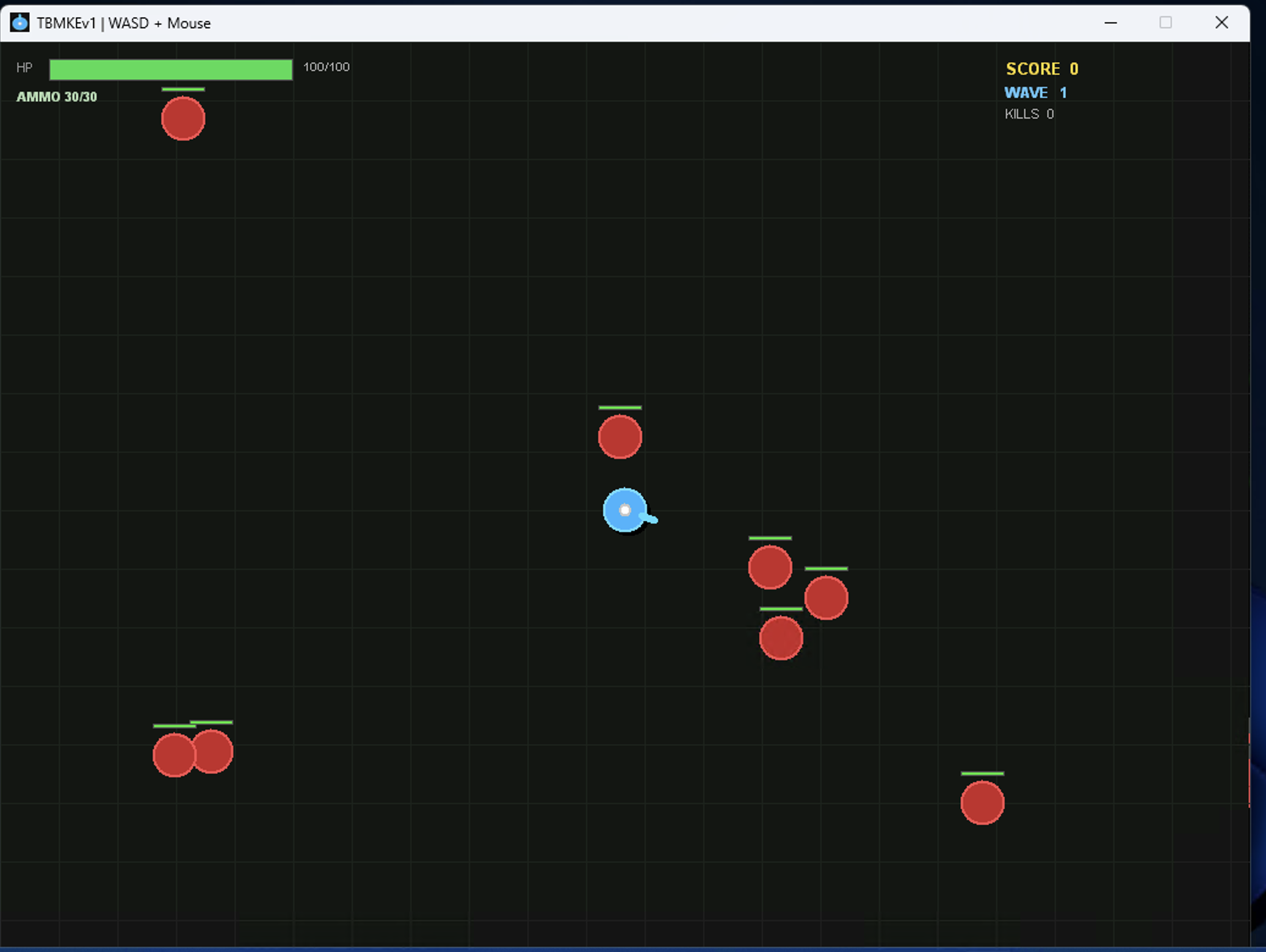
The challenge consists of three files of interest. The game
components with built in anti-cheat: TBM.exe, a kernel
driver TBMKD.sys and a Watchdog binary
WatchdogMain.exe.
TBM.exe Analysis
IDA identifies the WinMain function, the first function
called is then sub_140024DD0
Memory Integrity Check
CRC32 Hashing The .text Section
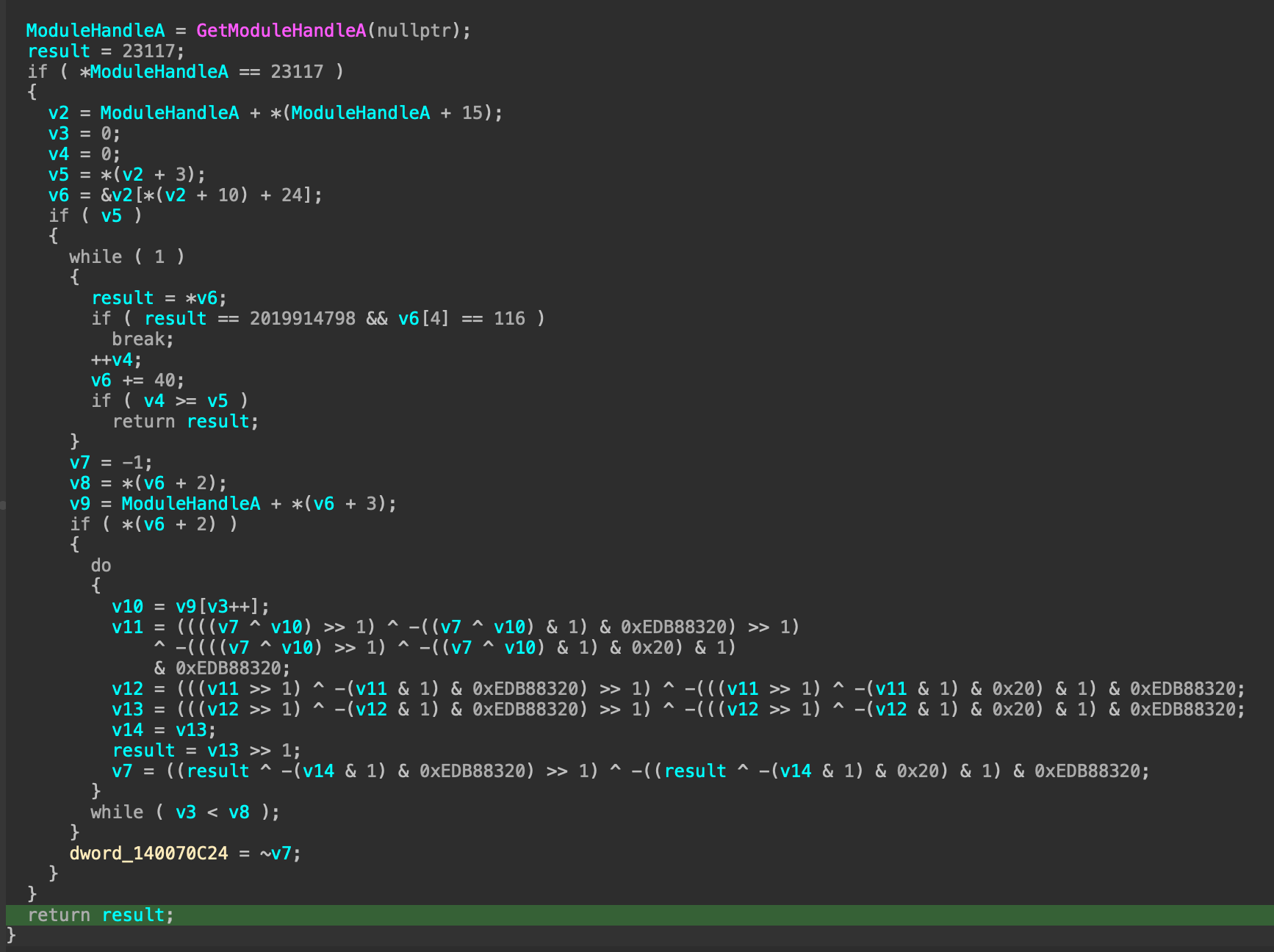
This first function gets a handle to the current executing module and checks that it’s a portable executable:
ModuleHandleA = GetModuleHandleA(nullptr);    // Base address of current executable
Result = IMAGE_DOS_SIGNATURE;                 // 0x4d5a
if ( *(_WORD *)ModuleHandleA == IMAGE_DOS_SIGNATURE )// Check we're an executable
It then identifies the IMAGE_SECTION_HEADER, and looks for the .text section:
e_lfanew = (char *)ModuleHandleA + *((int *)ModuleHandleA + 0xF);// int = 4, 0xF x 4 = 0x3C = Offset to PE Header (e_lfanew)
 v2 = 0;
 counter = 0;
 number_of_sections = *((_WORD *)e_lfanew + 3);
 section_headers = &e_lfanew[*((unsigned __int16 *)e_lfanew + 10) + 24];// Some pointer arithmetic to land at IMAGE_SECTION_HEADER
 if ( number_of_sections )
 {                                           // Looks for .text section
   while ( *(_DWORD *)section_headers != 'xet.' || section_headers[4] != 't' )
   {
     ++counter;
     section_headers += 40;
     if ( counter >= number_of_sections )
       return;
The function then calculates the CRC32 hash of the .text section and writes the result to a global variable:
if ( *((_DWORD *)section_headers + 2) )
{
  do
  {
    v10 = (unsigned __int8)v9[v3++];
    v11 = ((((v7 ^ v10) >> 1) ^ -(((unsigned __int8)v7 ^ (unsigned __int8)v10) & 1) & 0xEDB88320) >> 1)// 0xEDB88320 = CRC32 hash
        ^ -(((unsigned __int8)((v7 ^ v10) >> 1) ^ -(((unsigned __int8)v7 ^ (unsigned __int8)v10) & 1) & 0x20) & 1)
        & 0xEDB88320;
    v12 = (((v11 >> 1) ^ -(v11 & 1) & 0xEDB88320) >> 1)
        ^ -(((unsigned __int8)(v11 >> 1) ^ -(v11 & 1) & 0x20) & 1)
        & 0xEDB88320;
    v13 = (((v12 >> 1) ^ -(v12 & 1) & 0xEDB88320) >> 1)
        ^ -(((unsigned __int8)(v12 >> 1) ^ -(v12 & 1) & 0x20) & 1)
        & 0xEDB88320;
    v14 = v13;
    Result = (unsigned __int64)(v13 >> 1);
    v7 = (((unsigned int)Result ^ -(v14 & 1) & 0xEDB88320) >> 1)
       ^ -(((unsigned __int8)Result ^ -(v14 & 1) & 0x20) & 1)
       & 0xEDB88320;
  }
  while ( v3 < v8 );
}
text_crc32_hash = ~v7;                    // Calculates CRC32 hash of .text section
This function does not perform any checks itself, but is used to
calculate the hash and store the value. We can check cross references to
text_crc32_hash to see where this gets used.
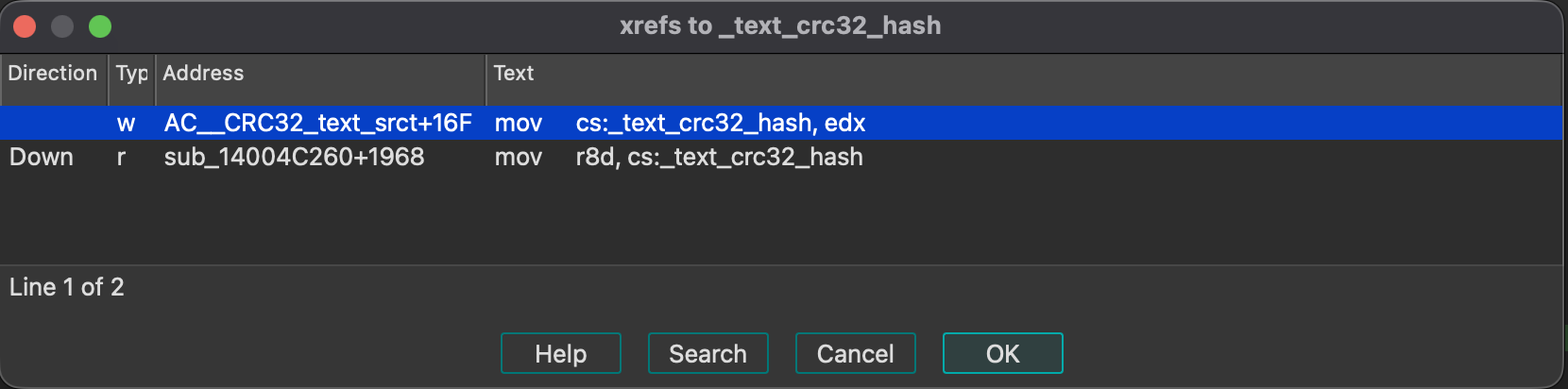
Encrypting And Storing The Hash
We are presented with the following code:
text_hash = text_crc32_hash;                // Local variable = Global variable
if ( !text_crc32_hash )                     // If no hash value
  text_hash = AC::Other_CRC32_text_hash();  // Calculate a new one
if ( text_hash_xor_1 )
{
  text_hash_xor_2 = ::text_hash_xor_2;
  if ( ::text_hash_xor_2 )
  {
    text_hash_xor_3 = ::text_hash_xor_3;
    if ( ::text_hash_xor_3 )
    {
      if ( ::encoding_key )// derived from PID ^ TickCount, meaning this key is different each run
      {
        encoding_key_1 = *::encoding_key;
        *text_hash_xor_1 = *::encoding_key ^ (text_hash >> 22) ^ 0x13375EED;// Store first XOR'd result
        *text_hash_xor_2 = (3 * encoding_key_1) ^ (text_hash >> 11) & 0x7FF ^ 0xFEEDF00D;// Store second XOR'd result
        *text_hash_xor_3 = text_hash & 0x7FF ^ (7 * encoding_key_1) ^ 0xC001C0DE;// Store third XOR'd result
      }
    }
  }
The anti-cheat stores 3 values calculated from XOR operations against the CRC32 hash of the .text section.
Looking at cross references to these globals, we see them being used
in three functions. One of which is at sub_140037490 and
acts as a one shot check pretty early on in WinMain. The
other is performed in sub_140042E50 as part of a thread and
is run in an infinite loop. This thread function also performs
additional checks which we haven’t looked at yet. The third is
sub_14004C260, which is our current function. It’s huge and
performs a lot of initialisation.
Saving .text Section Bytes
Within sub_14004C260, a copy of the .text bytes are
stored in a global variable:
v152 = v146 + *(v150 + 12);
v153 = *(v150 + 8);
text_section_size = v153;                   // VirtualSize of .text
live_text_section = v152;                   // module_base + VirtualAddress
v154 = GetProcessHeap();
copy_text_section = HeapAlloc(v154, 0, v153);
::copy_text_section = copy_text_section;
if ( copy_text_section )
  memcpy(copy_text_section, live_text_section, text_section_size);
Performing The Integrity Check
The memory integrity logic in sub_140042E50 and
sub_140037490 is nearly identical. It essentially checks
the hash that was calculated early on in execution vs a newly calculated
hash.
new_text_hash = AC::Other_CRC32_text_hash();previous_text_hash = ((*text_hash_xor_3 ^ (7 * v4)) ^ 0xDE) & 0x7FF | (((*text_hash_xor_1 ^ *v2) << 22) ^ 0xBB7FFFFF) & 0xFFC00000 | ((6144 * v4) ^ ((*text_hash_xor_2 ^ 0xD) << 11)) & 0x3FF800;if ( new_text_hash != previous_text_hash )
{
v69 = v1;
if ( copy_text_section )
{
sub_140024A50(&byte_140070B0D, 1);
if ( VirtualProtect(live_text_section, text_section_size, 0x40u, flOldProtect) )
{
memcpy(live_text_section, copy_text_section, text_section_size);
VirtualProtect(live_text_section, text_section_size, flOldProtect[0], flOldProtect);
}A new hash is calculated from the live .text section. It is compared against the previously stored result, and if they do not match, the section is patched with the previous .text section’s bytes.
The anti-cheat then creates a thread, the function of which spawns a message box:
  strcpy(Caption, "Anti-Cheat");
  MessageBoxA(nullptr, lpThreadParameter, Caption, 0x41010u);
  free(lpThreadParameter);
  return 0;
The process is then terminated.
CurrentProcess = GetCurrentProcess();
TerminateProcess(CurrentProcess, 1u);
String Encryption
Back to the WinMain function we’re presented with string
encryption.
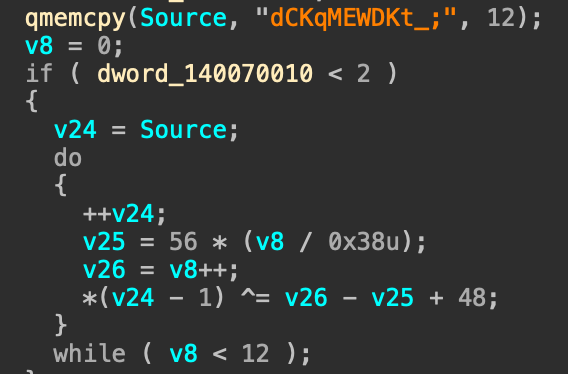
The string encryption works by XORing the first byte with the hex
value 0x30 (Or ASCII 0), and increasing by 1 for each byte
(second byte XOR’d with 0x31, then 0x32, etc).
  qmemcpy(Source, "dCKqMEWDKt_;", 12);
  counter = 0;
  if ( dword_140070010 < 2 )
  {
    ciphertext = Source;
    do
    {
      ++ciphertext;
      v25 = 56 * (counter / 56u);
      i = counter++;
      *(ciphertext - 1) ^= i - v25 + 0x30;
    }
    while ( counter < 12 );
The ASCII representation if 0x30 - 0x42 is ‘0123456789:;’, as such, we can use the following Binary Refinery pipeline to decrypt this string:
emit 'dCKqMEWDKt_;' | xor '0123456789:;'
TryBypassMe
A better alternative is to use the alu module and custom
expression:
emit <ciphertext> | alu "B ^ ((K % 56) + 52)"Admin Check
The anti-cheat the proceeds to check if it’s running in an elevated state:
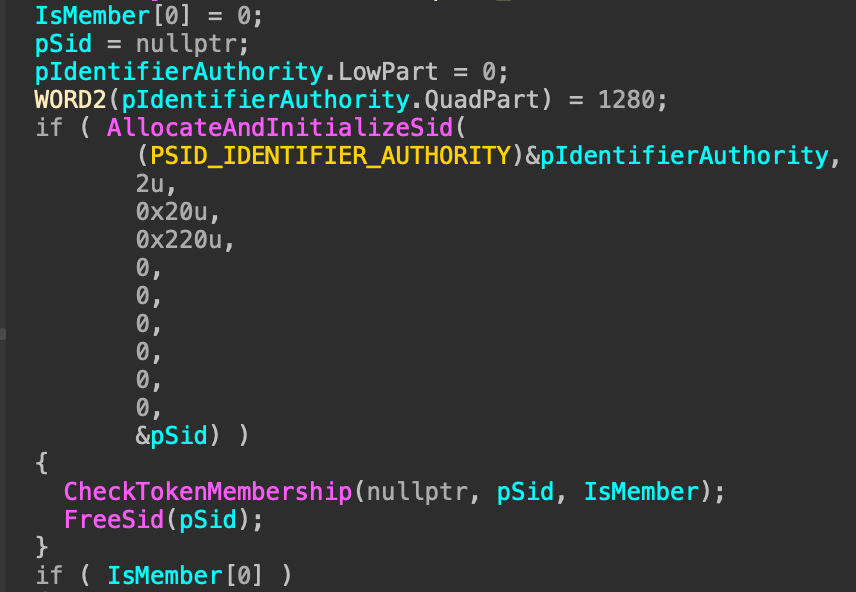
If it is not, it simply prompts the user to either re-open as admin, or exit.
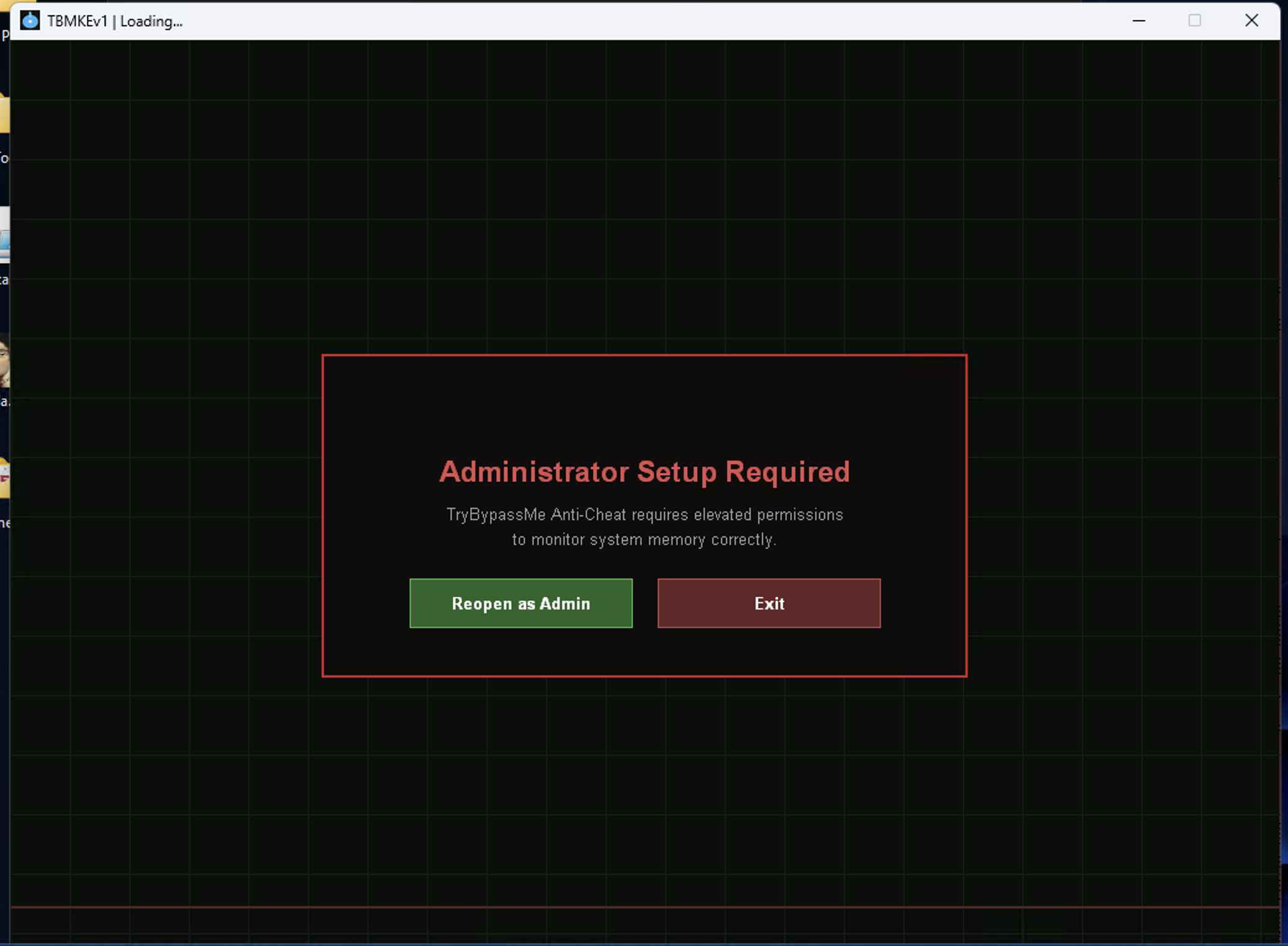
The program can then re-open as administrator, or simply terminate:
GetModuleFileNameA(nullptr, Filename, 0x104u);
strcpy(IsMember, "runas");
ShellExecuteA(nullptr, IsMember, Filename, nullptr, nullptr, 1);
AC::teardown();
The function I named AC::teardown function closes
connection to the driver and stops and deletes the service
TBMKEv1. This function is called numerous times throughout
the binary on every exit path.
If the process is running in an elevated state, we head into a
function I namedAntiCheat_init. We partly analysed this
function earlier when we followed through with our memory integrity
analysis.
File Integrity Check
The first function called in AntiCheat_init is
sub_14002C1D0. This function was relatively easy to
recognise as it’s similar to the previous memory integrity check we
analysed in that it reutns a CRC32 hash. In this case, it’s returning a
hash of the current running executable (TBM.exe).
  memset(Filename, 0, 260u);
  GetModuleFileNameA(nullptr, Filename, 0x104u);// Returns file name of current executed process
  FileA = CreateFileA(Filename, 0x80000000, 1u, nullptr, 3u, 0x80u, nullptr);// Gets handle to itself
  v1 = FileA;
  if ( FileA == -1LL )
    return 0;
  NumberOfBytesRead = 0;
  CRC32_hash = -1;
  if ( ReadFile(FileA, Buffer, 0x1000u, &NumberOfBytesRead, nullptr) )// Reads itself
  {
    do
    {
      if ( !NumberOfBytesRead )
        break;
      v4 = Buffer;
      v5 = NumberOfBytesRead;
      do
      {                                         // Calculates CRC32 hash of itself
        v6 = *v4++;
        v7 = ((((CRC32_hash ^ v6) >> 1) ^ -((CRC32_hash ^ v6) & 1) & 0xEDB88320) >> 1)// 0xEDB88320 = CRC32
           ^ -((((CRC32_hash ^ v6) >> 1) ^ -((CRC32_hash ^ v6) & 1) & 0x20) & 1)
           & 0xEDB88320;
        v8 = (((v7 >> 1) ^ -(v7 & 1) & 0xEDB88320) >> 1) ^ -(((v7 >> 1) ^ -(v7 & 1) & 0x20) & 1) & 0xEDB88320;
        v9 = (((v8 >> 1) ^ -(v8 & 1) & 0xEDB88320) >> 1) ^ -(((v8 >> 1) ^ -(v8 & 1) & 0x20) & 1) & 0xEDB88320;
        CRC32_hash = (((v9 >> 1) ^ -(v9 & 1) & 0xEDB88320) >> 1) ^ -(((v9 >> 1) ^ -(v9 & 1) & 0x20) & 1) & 0xEDB88320;
        --v5;
      }
      while ( v5 );
    }
    while ( ReadFile(v1, Buffer, 0x1000u, &NumberOfBytesRead, nullptr) );
  }
  CloseHandle(v1);
  return ~CRC32_hash;                           // Return calculated CRC32 hash
}
This hash is XOR’d twice and stored in two global variables:
  TBM_CRC32_hash = AC::Calc_TBM_exe_CRC32();
  if ( qword_140070AB0 && XORed_TBM_CRC32_hash_0 && XORed_TBM_CRC32_hash_1 )
  {
    key = *qword_140070AB0 ^ dword_140070C50;
    *XORed_TBM_CRC32_hash_0 = key ^ TBM_CRC32_hash;
    *XORed_TBM_CRC32_hash_1 = TBM_CRC32_hash ^ ~key;// Inverted
Looking at cross references, these values are used again in
sub_140037B70 and sub_14003E790:
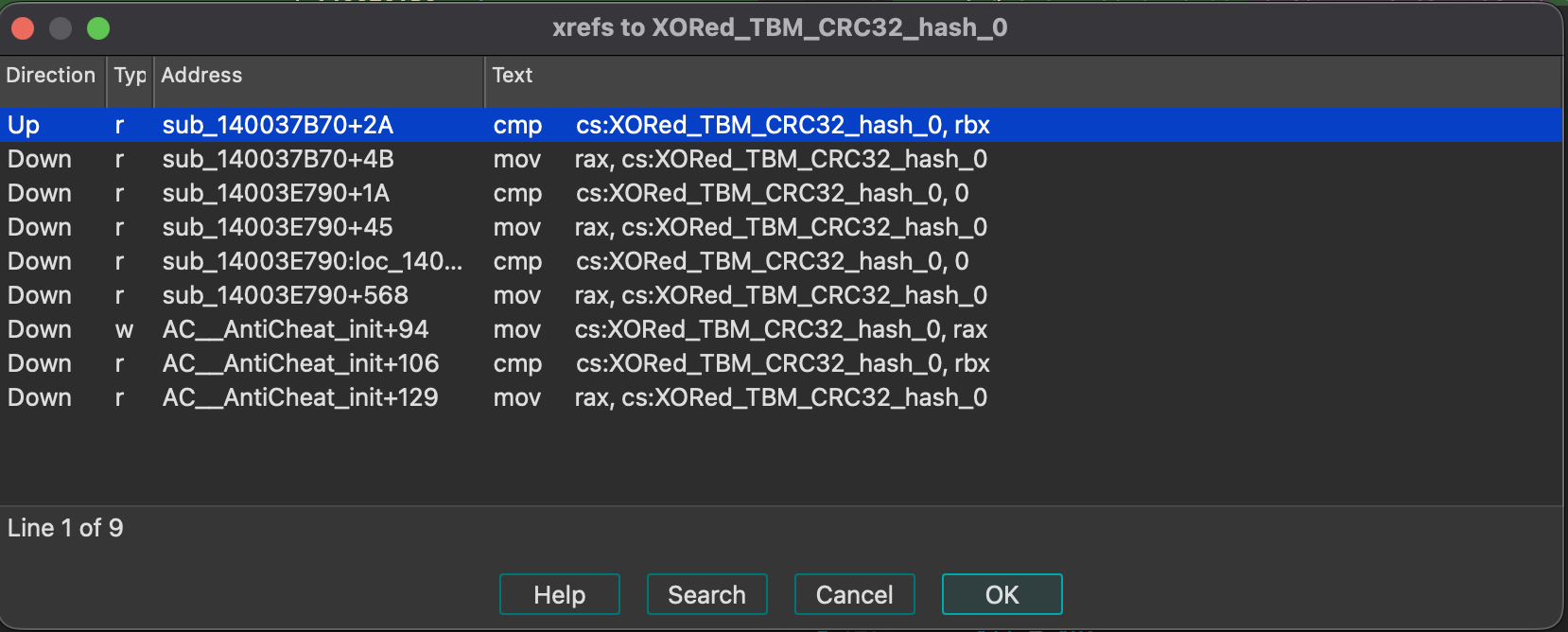
In sub_140037B70, the anti-cheat first decrypts the
values back to the hash and verifies they match:
if ( qword_140070AB0 && XORed_TBM_CRC32_hash_0 && XORed_TBM_CRC32_hash_1 )
{
  XOR_key = *qword_140070AB0 ^ dword_140070C50;
  inverted_XOR_key = ~XOR_key;
  TBM_CRC32_hash_0 = *XORed_TBM_CRC32_hash_0 ^ XOR_key;
  TBM_CRC32_hash_1 = *XORed_TBM_CRC32_hash_1 ^ inverted_XOR_key;
  verify_hash_match = TBM_CRC32_hash_0 == TBM_CRC32_hash_1;
Next comes the logic if the newly calculated hash does not match the hash previously calculated:
if ( TBM_CRC32_hash_0 && AC::Calc_TBM_exe_CRC32() != TBM_CRC32_hash_0 )In this case, the following prompt is shown:
[!] CHEAT DETECTED

Reason: Disk CRC storage tampered (key mismatch)

Game will terminate.
and the process terminates:
CreateThread(nullptr, 0, AntiCheat_msg, v84, 0, nullptr);
Sleep(0x1388u);
AC::teardown();
Proc = GetCurrentProcess();
TerminateProcess(Proc, 1u);
v88 = AC::calls_NtTerminateProcess(v86, v117);
sub_14003E790 follows very similar logic, and will
terminate and show the following message:
 [!] CHEAT DETECTED

 Reason: Disk CRC tampered (failed rekey)

 Game will terminate.
Anti-Debugging
The first check is a simple call to the Windows API
IsDebuggerPresent.
if ( IsDebuggerPresent() )The other checks involve:
ProcessDebugPort:
HMODULE ntdll = GetModuleHandleA("ntdll.dll");
auto NtQIP = GetProcAddress(ntdll, "NtQueryInformationProcess")
DWORD debug_port = 0;
NTSTATUS s2 = NtQIP(GetCurrentProcess(), 7 &debug_port, 4, NULL);
if (NT_SUCCESS(s2) && debug_port != 0) {
trigger("[!] CHEAT DETECTED\n\nReason: Debugger(DebugPort)\n\nGame will terminate.");
}
ProcessDebugFlags:
DWORD debug_flags = 1;
NTSTATUS s3 = NtQIP(GetCurrentProcess(), 0x1F, &debug_flags, 4, NULL);
if (NT_SUCCESS(s3) && debug_flags == 0) {
trigger("[!] CHEAT DETECTED\n\nReason: Debugger (DebugFlags)\n\nGame will terminate.")
}
PEB.NtGlobalFlag:
PEB* peb = (PEB*)__readgsqword(0x60);
if (peb->NtGlobalFlag & 0x70) {
    trigger("[!] CHEAT DETECTED\n\nReason: Debugger (NtGlobalFlag)\n\nGame will terminate.");
}
Hardware breakpoints:
CONTEXT ctx = {};
ctx.ContextFlags = CONTEXT_DEBUG_REGISTERS;
GetThreadContext(GetCurrentThread(), &ctx)
if (ctx.Dr0 || ctx.Dr1 || ctx.Dr2 || ctx.Dr3) {
    trigger("[!] CHEAT DETECTED\n\nReason: Hardware breakpoints (DR0-DR3)\n\nGame will terminate.");
}
Process Enumeration
Three functions exist to detect running process that might be used to
debug / cheat. These are at 0x14002CD10,
0x14002EDE0 and 0x1400389A0.
0x14002CD10 uses the Windows API
CreateToolhelp32Snapshot to scan all running processes and
compare them against a list.
0x14002EDE0 does a similar thing, but uses
EnumWindows to scan process window titles.
0x1400389A0 also uses
CreateToolhelp32Snapshot, but it scans for loaded modules
rather than processes.
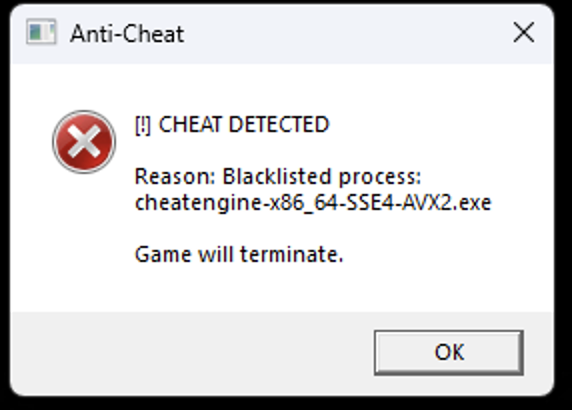
The following error is displayed if a blocklisted process is found, followed by the process being terminated:
Looped Thread Function
As mentioned earlier there is further functionality includded in the
sub_140042E50 function, which I’ll take quick look at
now.
Function Hooking Detection
Within the thread sub_140042E50, a call is made to
sub_140025530. This function is responsible for checking
the integrity of the init function we called AntiCheat_init
for any hooking / tampering. There’s quite a lot going on so I don’t
want to spend too much time looking at each function.
The function checks the first bytes of the function for common inline hooks:
if ( *AC::AntiCheat_init == 0xE9 )
{
  v3 = *(AC::AntiCheat_init + 1);
  v4 = &loc_14004C263 + 2;
}
else
{
  if ( *AC::AntiCheat_init != 0xEB )
    goto LABEL_11;
IAT Hook Detection
Firslty, DLLs are resolved. The Import Directory is then walked and validated for matching DLL names.
offsets = (*(*handle_to_self + 0x3CLL) + *handle_to_self + 0x90LL);The DLLS checked are: * win32u.dll *
kernel32.dll * ntdll.dll *
kernelbase.dll * msvcrt.dll
Check .text Section Characteristics
The next check looks for its own .text section and whether it has been made writable.
Find .text section:
qmemcpy(&v72, ".texL9", 6);
if ( v8 == v72.m128i_i32[0] && *(v7 + 4) == 't' )
Query the section:
memset(&Buffer, 0, sizeof(Buffer));
if ( !VirtualQuery(v10, &Buffer, 0x30u) )
Check the characteristics:
v12 = Buffer.Protect & 0xFFFFFCFF;
LOBYTE(v11) = (Buffer.Protect & 0xFFFFFCFF) == PAGE_EXECUTE_READWRITE
           || v12 == PAGE_EXECUTE_WRITECOPY
           || v12 == PAGE_READWRITE
           || v12 == PAGE_WRITECOPY;
Further Integrity Checks
Many of the other functions called involve hashing a specific component, and later checking it and validating the result of a newly genereated hash, ensuring no tampering has taken place.